
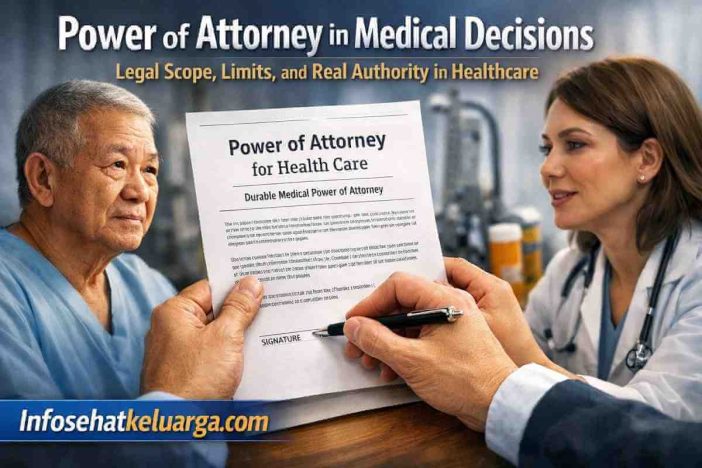
Power of attorney in medical decisions becomes critical when illness, injury, or cognitive decline prevents someone from communicating their wishes. In those moments, hospitals do not rely on assumption or family hierarchy—they rely on legal authority.
Without a valid medical power of attorney, disagreements among relatives, confusion about consent, and delays in treatment may occur. Understanding the legal scope and limits of power of attorney in medical decisions allows families to protect patient autonomy while preventing conflict in high-pressure medical situations.
This guide explains how medical power of attorney works, what authority it grants, and the boundaries that even designated decision-makers must respect.
What Is Power of Attorney in Medical Decisions?
A medical power of attorney (POA) is a legal document that authorizes another person to make healthcare decisions on behalf of a patient who cannot decide independently.
The appointed person—often called a healthcare proxy or agent—is responsible for representing the patient’s wishes.
Medical POA typically becomes active when:
- A patient loses decision-making capacity
- Physicians certify incapacity
- The patient cannot communicate treatment preferences
The purpose is to ensure medical decisions reflect the patient’s intentions, not family disagreement.
This legal authority framework is part of the broader Family Health Law, Rights & Medical Liability structure that governs responsibility in healthcare decisions.
Why Medical Power of Attorney Exists
Medical systems require clear authority during emergencies or incapacity.
Without documented authority:
- Multiple relatives may claim decision rights
- Hospitals may delay treatment
- Ethical disputes may arise
- Courts may need to intervene
Medical POA prevents these situations by clearly identifying a decision-maker before a crisis occurs.
Power of Attorney vs Advance Directives
Many families confuse these documents.
Understanding power of attorney in medical decisions requires distinguishing two related tools.
Advance Directive
Advance directives describe the patient’s treatment preferences.
They may specify:
- Life support wishes
- Artificial nutrition
- Resuscitation preferences
They answer the question:
What treatment should occur?
This concept is explored further in Advance Directives and Family Authority in Medical Decisions.
Medical Power of Attorney
Medical POA designates a person who will interpret and apply those wishes.
It answers a different question:
Who makes decisions when the patient cannot?
Both documents work together but serve different roles.
When Medical Power of Attorney Takes Effect
In most healthcare systems, medical POA activates only after incapacity is confirmed.
Common triggers include:
- Severe neurological injury
- Coma
- Advanced dementia
- Critical illness affecting cognition
Until incapacity is established, the patient retains full decision authority.
This principle aligns with patient autonomy explained in Understanding Patient Rights in Family Healthcare Decisions.
Legal Scope of Medical Power of Attorney
The agent appointed through medical POA may be authorized to:
- Consent to or refuse treatment
- Approve surgery
- Decide on life-support measures
- Authorize transfers between facilities
- Access medical information
However, authority is not unlimited.
Limits of Power of Attorney in Medical Decisions
Even with legal authority, agents must follow strict boundaries.
Medical POA does not allow agents to:
- Override the patient’s known wishes
- Demand medically inappropriate treatment
- Act in personal interest rather than patient interest
- Violate hospital policy or law
Healthcare providers may challenge decisions that conflict with professional standards.
In such situations, ethical review may occur through hospital mechanisms explained in How Hospital Ethics Committees Work in Family Disputes.
What Happens If the Agent and Doctors Disagree?
Disagreement does not automatically invalidate medical POA authority.
However, hospitals may review decisions if:
- The agent appears to act against the patient’s interests
- Evidence suggests coercion
- Requested treatment violates medical standards
These situations resemble conflicts discussed in When Families Disagree With Doctors: Rights, Limits, and Safe Resolution.
Resolution may involve:
- Ethics consultation
- Administrative review
- Legal intervention in rare cases
Real-World Scenario
Consider a patient with advanced neurological disease who becomes unable to communicate.
The medical POA agent refuses aggressive surgery, citing the patient’s previous wishes.
Relatives disagree and demand intervention.
In this situation:
- The agent’s authority typically prevails
- Hospitals rely on documented POA
- Family preference alone does not override legal authority
Understanding power of attorney in medical decisions prevents such disputes from escalating unnecessarily.
Expert Insight: Choosing the Right Healthcare Agent
Selecting a medical POA agent is one of the most important healthcare planning decisions.
Ideal agents:
- Understand the patient’s values
- Can remain calm during crisis
- Are capable of communicating with medical teams
- Are willing to prioritize the patient’s wishes over personal emotion
Poorly chosen agents often become the source of family conflict.
Practical Steps to Create Medical Power of Attorney
Families should take the following steps:
- Discuss healthcare preferences openly.
- Choose a trusted decision-maker.
- Draft a legally valid document.
- Provide copies to healthcare providers.
- Review documents periodically.
Preparation before illness is essential.
Frequently Asked Questions
Can multiple people hold medical power of attorney?
Usually one primary agent is appointed, sometimes with backup agents.
Can a patient revoke medical POA?
Yes. A competent patient may revoke the document at any time.
Does medical POA override advance directives?
No. Advance directives guide the agent’s decisions.
Can hospitals ignore medical POA?
Only in rare situations involving legal concerns or patient safety.
Why Medical Power of Attorney Prevents Family Conflict
Clear authority reduces uncertainty.
When power of attorney in medical decisions is properly established:
- Families understand who decides
- Hospitals avoid delays
- Ethical disputes decrease
- Patient autonomy is preserved
Structure prevents emotional escalation.
Bottom Line
Medical crises rarely provide time for legal clarification. Decisions must be made quickly, often under immense emotional pressure.
A properly established power of attorney in medical decisions ensures that the patient’s voice continues to guide care—even when the patient can no longer speak. In healthcare, the most powerful form of protection is preparation.