
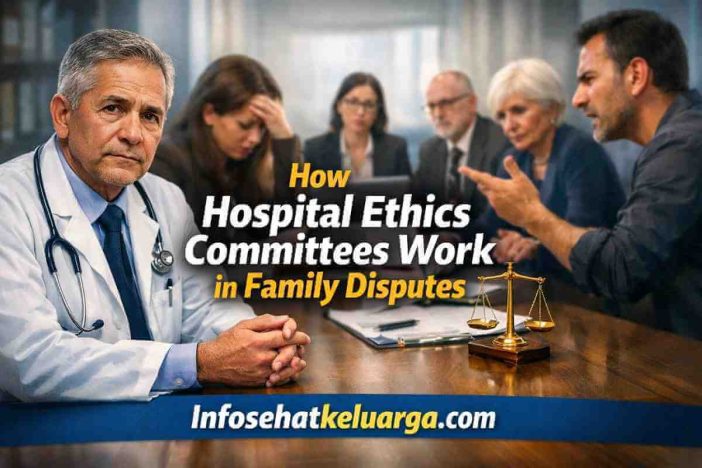
How hospital ethics committees work in family disputes is a question that often arises only after disagreement has reached a breaking point. Families may feel unheard. Physicians may feel their professional judgment is being challenged. Emotions rise, communication tightens, and trust begins to fracture.
In these moments, ethics committees do not function as courts, nor as mediators in the legal sense. Instead, they provide structured ethical review, clarify decision authority, and help restore dialogue grounded in patient rights and medical standards. Understanding how hospital ethics committees work in family disputes helps families approach conflict with clarity rather than escalation.
What Is a Hospital Ethics Committee?
A hospital ethics committee is a multidisciplinary group typically composed of:
- Physicians
- Nurses
- Social workers
- Legal advisors
- Chaplains or ethicists
- Community representatives
Its purpose is to examine ethically complex situations where:
- Family and medical teams disagree
- Treatment goals are contested
- Life-sustaining care is debated
- Patient capacity is unclear
Ethics committees do not replace legal systems. They operate within institutional frameworks to support ethically sound decision-making.
This explanation forms part of our broader Family Health Law, Rights & Medical Liability framework, where we examine how authority, accountability, and patient protection operate across complex healthcare disputes.
Why Ethics Committees Become Involved in Family Disputes
When families disagree with doctors, as explained in our guide When Families Disagree With Doctors: Rights, Limits, and Safe Resolution, escalation often occurs because:
- Authority is misunderstood
- Prognosis is interpreted differently
- Emotional distress overrides structured dialogue
Ethics committees are typically consulted when:
- Conflict persists after discussion
- Communication has broken down
- Ethical uncertainty exists
- The care team requests review
They are not automatically involved in every disagreement.
How Hospital Ethics Committees Work in Family Disputes Step by Step
Understanding how hospital ethics committees work in family disputes requires examining the process.
Step 1: Formal Consultation Request
A consultation may be requested by:
- The treating physician
- A family member
- Nursing staff
- Hospital administration
The request identifies the ethical issue—not the accusation.
Step 2: Case Review and Information Gathering
The committee reviews:
- Medical records
- Prognosis details
- Consent documentation
- Advance directives
- Family perspectives
Clarity about decision authority—outlined in Understanding Patient Rights in Family Healthcare Decisions—is central at this stage.
Step 3: Ethical Analysis
The committee evaluates:
- Patient autonomy
- Beneficence (acting in patient’s best interest)
- Non-maleficence (avoiding harm)
- Justice (fair allocation of resources)
These principles align with broader discussions in our Medical Ethics, Consent & Decision-Making section.
Step 4: Recommendation (Not a Verdict)
Ethics committees typically issue recommendations—not binding orders.
Their goal is to:
- Clarify ethical considerations
- Facilitate dialogue
- Reduce misunderstanding
- Support safe resolution
Final decision authority remains with legally authorized parties.
Do Ethics Committees Have Legal Power?
A common misconception is that ethics committees function like courts.
They do not:
- Overrule competent patients
- Force treatment against consent
- Issue legal judgments
Their influence is advisory, though often persuasive.
If disputes escalate beyond ethical disagreement into allegations of negligence, the distinction discussed in Medical Negligence vs Medical Complications becomes relevant.
When Ethics Committees Cannot Resolve the Conflict
There are limits.
Ethics committees may be unable to resolve disputes when:
- Legal guardianship is contested
- Court intervention is required
- Family members disagree among themselves
- There is alleged professional misconduct
In such cases, formal legal review may follow.
Real-World Scenario: Life-Sustaining Treatment Dispute
Consider a case:
- A patient lacks decision-making capacity.
- Doctors believe continued aggressive treatment offers no meaningful benefit.
- Family insists on full intervention.
How hospital ethics committees work in family disputes here typically involves:
- Reviewing prognosis objectively
- Clarifying patient’s prior expressed wishes
- Exploring ethical obligations
- Encouraging structured dialogue
The committee does not decide whether life should continue—it clarifies how decisions should be made responsibly.
Expert Insight: When Families Should Consider Requesting Ethics Review
Families may reasonably request ethics consultation if:
- They feel communication is unclear
- Medical recommendations shift without explanation
- Treatment goals are disputed
- Advance directives appear ignored
Requesting review is not hostile—it is structured.
Approach matters. Framing it as a search for clarity rather than accusation increases cooperation.
Frequently Asked Questions About Hospital Ethics Committees
Can families request an ethics committee review?
Yes, in most hospitals.
Is the committee’s recommendation legally binding?
Usually not. It is advisory.
Does ethics consultation mean malpractice occurred?
No. It signals ethical complexity, not wrongdoing.
Will requesting ethics review harm the doctor-patient relationship?
When approached respectfully, it often strengthens communication rather than damages it.
Why Understanding How Hospital Ethics Committees Work in Family Disputes Prevents Escalation
Conflict thrives in uncertainty.
When families understand how hospital ethics committees work in family disputes:
- Fear decreases
- Communication improves
- Emotional escalation slows
- Structured dialogue replaces confrontation
Ethics committees exist not to punish—but to clarify.
🔹 Bottom Line: Structure Before Escalation
Healthcare decisions are rarely simple. Disagreement is human. Escalation is preventable.
Understanding how hospital ethics committees work in family disputes equips families to seek structured resolution before conflict hardens into distrust. In ethically complex situations, clarity—not control—is what protects everyone involved.
Reference
- Ethical consultation models used in major academic hospitals
- Professional guidelines referenced by national bioethics associations
This article follows Infosehatkeluarga.com’s Editorial Policy and Content Review & Verification Policy and is provided for educational and informational purposes only.