
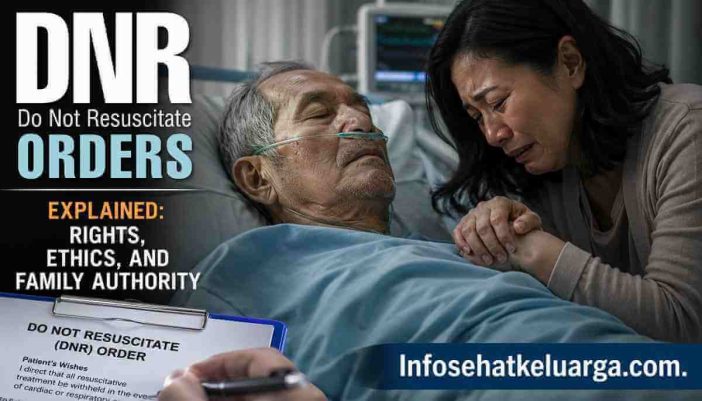
Do Not Resuscitate (DNR) orders are often misunderstood as decisions about whether a life is “worth saving.” In reality, they are highly specific medical instructions created to guide healthcare teams during one of the most critical moments in medicine: cardiac or respiratory arrest.
The emotional weight surrounding DNR decisions often causes families to confuse treatment limitation with abandonment of care. Some believe a DNR means doctors will stop treatment entirely. Others assume family members automatically control the decision. In many cases, neither assumption is accurate.
Understanding how DNR orders actually work—legally, medically, and ethically—helps families avoid panic-driven conflict and make decisions grounded in patient wishes rather than fear.
This article is part of our broader Family Health Law, Rights & Medical Liability framework, where we examine how authority, accountability, and patient protection intersect in complex healthcare decisions.
What a DNR Order Actually Means
A Do Not Resuscitate (DNR) order instructs healthcare providers not to perform cardiopulmonary resuscitation (CPR) if a patient’s heart stops beating or breathing stops.
A DNR typically applies to:
- chest compressions,
- defibrillation,
- emergency ventilation,
- advanced cardiac resuscitation procedures.
A DNR does not automatically mean:
- all treatment stops,
- pain management ends,
- nutrition is withdrawn,
- comfort care disappears.
Patients with DNR orders may still receive:
- antibiotics,
- oxygen,
- dialysis,
- surgery,
- pain relief,
- ongoing medical care.
This distinction is one of the most misunderstood parts of DNR discussions.
Why DNR Orders Exist
Modern medicine can prolong biological function even when recovery chances are extremely limited.
DNR orders exist to:
- respect patient wishes,
- avoid invasive interventions unlikely to provide meaningful benefit,
- reduce unnecessary suffering,
- clarify emergency response expectations.
In many hospitals, DNR discussions arise during:
- advanced illness,
- terminal conditions,
- severe neurological injury,
- late-stage chronic disease,
- frailty in elderly patients.
Who Has Authority Over DNR Decisions?
Authority depends on patient capacity and legal documentation.
If the Patient Can Decide
A competent adult patient generally has the right to:
- request a DNR,
- refuse resuscitation,
- revoke a DNR.
This principle reflects patient autonomy discussed in Understanding Patient Rights in Family Healthcare Decisions.
Family members cannot automatically override a competent patient’s decision simply because they disagree emotionally.
If the Patient Cannot Decide
If capacity is lost, authority may shift to:
- a healthcare proxy,
- medical power of attorney,
- legally recognized surrogate decision-maker.
This authority structure is explored further in:
Hospitals typically rely on documented legal authority rather than verbal family preference.
DNR Orders and Advance Directives
Many people incorrectly assume these are the same document.
They are related—but different.
Advance Directives
Advance directives outline:
- treatment wishes,
- end-of-life preferences,
- broader care goals.
DNR Orders
DNR orders specifically address:
- resuscitation during cardiac or respiratory arrest.
A patient may:
- have an advance directive without a DNR,
- have a DNR without a broader advance directive,
- or have both.
DNR vs Full Code
Hospitals often classify patients as:
- Full Code
- DNR
Full Code
Healthcare teams will attempt full resuscitation if cardiac arrest occurs.
DNR
Healthcare teams will not initiate CPR or advanced resuscitation measures.
This distinction affects emergency response—not all medical care.
Why Families Often Struggle With DNR Decisions
DNR conversations trigger:
- fear,
- guilt,
- grief,
- misunderstanding about “giving up.”
Family disagreement often arises because:
- relatives interpret suffering differently,
- prognosis is unclear,
- patient wishes were never discussed openly,
- religious or cultural values differ.
These conflicts resemble broader tensions discussed in When Families Disagree With Doctors: Rights, Limits, and Safe Resolution.
Ethical Tension Around DNR Orders
DNR decisions are rarely purely medical.
They often involve:
- dignity,
- quality of life,
- suffering,
- autonomy,
- moral responsibility.
Hospitals may involve ethics consultation when:
- family members disagree,
- treatment goals conflict,
- patient wishes are disputed.
This process is explained further in How Hospital Ethics Committees Work in Family Disputes.
Ethics committees do not decide whose emotions matter more. They clarify how decisions should be evaluated responsibly.
Common Misunderstandings About DNR Orders
“DNR Means No Treatment”
False.
A DNR only limits resuscitation efforts during cardiac or respiratory arrest.
“Families Always Decide”
Not necessarily.
Legal authority depends on:
- patient capacity,
- advance directives,
- proxy designation,
- jurisdictional law.
“Doctors Use DNR to Stop Caring”
DNR orders do not eliminate professional obligations.
Patients remain entitled to:
- comfort care,
- symptom management,
- medically appropriate treatment.
Practical Checklist Before Agreeing to a DNR
Families should clarify:
- What exactly the DNR covers
- Whether the patient has decision-making capacity
- Whether advance directives exist
- Who legally holds authority
- What treatments continue despite DNR status
- Whether palliative care is involved
Clear documentation prevents confusion later.
Real-World Scenario
An elderly patient with severe heart failure loses consciousness after repeated hospitalizations.
One adult child insists on “doing everything possible.” Another says the patient previously expressed a wish to avoid aggressive resuscitation.
The hospital reviews:
- advance directives,
- proxy documentation,
- prior expressed wishes,
- prognosis,
- ethical considerations.
Without clear authority documentation, conflict escalates rapidly.
Understanding Do Not Resuscitate (DNR) orders before crisis situations arise often prevents these disputes entirely.
Trust & Verification Note
Because DNR decisions involve high-risk medical and legal considerations, families should seek guidance from:
- licensed healthcare providers,
- hospital ethics services,
- legal professionals where appropriate,
- official advance care planning resources.
This article is educational and does not replace individualized medical or legal advice.
Frequently Asked Questions
Can a patient change a DNR order?
Yes. Competent patients may usually revise or revoke DNR decisions.
Does a DNR apply outside the hospital?
Sometimes, but additional documentation may be required depending on jurisdiction and emergency medical systems.
Can hospitals refuse family demands for CPR?
In some situations, yes—particularly when treatment is considered medically non-beneficial or conflicts with policy.
Is a DNR the same as hospice care?
No. A DNR only addresses resuscitation status.
Why Clarity Matters More Than Crisis Decisions
Most DNR conflicts begin long before the actual medical emergency. They begin when families avoid difficult conversations until emotions overwhelm structure.
Understanding Do Not Resuscitate (DNR) orders allows families to replace panic with preparation, conflict with clarity, and uncertainty with documented patient wishes.
In healthcare, preparation is one of the few forms of control families truly have.