
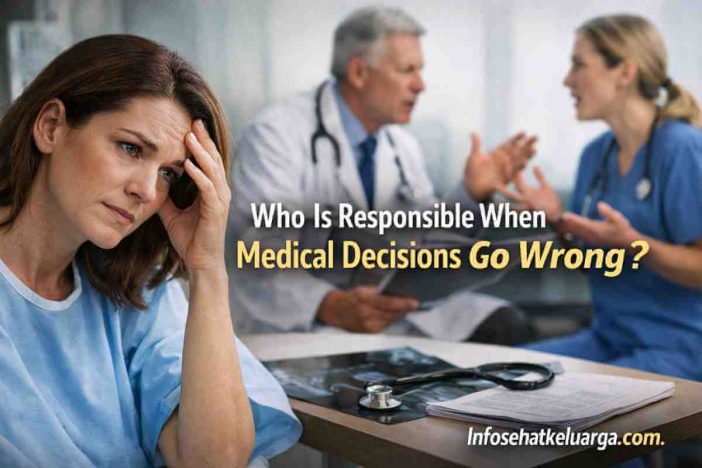
Who is responsible when medical decisions go wrong is one of the most emotionally charged questions families face in healthcare. Responsibility is often assumed to rest on a single person or institution, yet in reality it is shaped by a complex chain of decisions involving patients, families, healthcare professionals, and systems operating under uncertainty.
When responsibility is misunderstood, families may assign blame prematurely or overlook accountability where it truly belongs. This guide explains how responsibility is determined in medical decision-making—clearly, practically, and without speculation—so families can navigate difficult outcomes with clarity rather than accusation.
Why Responsibility in Medical Decisions Is Rarely Simple
Medical care is not a single action but a process. Decisions unfold across time, involving:
- Information sharing
- Consent and refusal
- Clinical judgment
- Systemic constraints
Understanding who is responsible when medical decisions go wrong requires examining the entire decision chain, not just the final outcome.
This framework is central to our broader Family Health Law, Rights & Medical Liability hub, which explores how authority, responsibility, and patient protection intersect in real-world care.
The Chain of Responsibility in Medical Decision-Making
Responsibility is distributed—not concentrated.
Patient Responsibility in Medical Decisions
Patients are responsible when they:
- Have decision-making capacity
- Receive adequate information
- Voluntarily accept or refuse treatment
A competent patient who knowingly declines recommended care may bear responsibility for resulting outcomes.
This principle is grounded in patient rights, explained in depth in our guide on Understanding Patient Rights in Family Healthcare Decisions.
Family Responsibility in Shared Medical Decisions
Families play a critical role, especially when patients:
- Are minors
- Lack capacity
- Require caregiving support
Family responsibility arises when decisions are made on behalf of the patient, particularly if:
- Risks were explained
- Alternatives were discussed
- Consent or refusal was documented
Emotional involvement does not replace legal or ethical responsibility—but it does influence decision dynamics.
Healthcare Provider Responsibility
Providers are responsible for:
- Meeting the accepted standard of care
- Communicating risks and options clearly
- Respecting patient autonomy
- Acting within professional and ethical boundaries
Responsibility does not extend to guaranteeing outcomes.
Understanding this distinction is critical to separating medical negligence from medical complications, as discussed in Medical Negligence vs Medical Complications.
How Informed Consent Shapes Responsibility
In disputes about who is responsible when medical decisions go wrong, informed consent is often decisive.
When informed consent is:
- Properly explained
- Understood
- Voluntary
- Documented
Responsibility for known risks may shift away from providers toward patients or families.
his is why informed consent—explained comprehensively in What Is Informed Consent in Medical Treatment?—is a cornerstone of responsible healthcare.
System Responsibility: Hospitals, Policies, and Constraints
Responsibility does not exist only at the individual level.
Healthcare systems influence decisions through:
- Hospital protocols
- Resource limitations
- Staffing structures
- Regulatory requirements
When outcomes go wrong, system factors may explain delays or limitations that appear, at first glance, to be personal failures.
When Responsibility Does Not Mean Negligence
A poor outcome does not automatically imply fault.
In many cases:
- All parties acted reasonably
- Known risks materialized
- Decisions were made under uncertainty
Assigning responsibility requires evidence of avoidable deviation, not hindsight dissatisfaction.
This ethical dimension is explored further in our Medical Ethics, Consent & Decision-Making section, where responsibility is examined beyond legal blame.
Common Scenarios Where Responsibility Is Misunderstood
Delayed Treatment Due to Family Disagreement
When families delay decisions while seeking consensus, responsibility may rest with decision-makers—not providers.
Refusal of Recommended Care
A documented refusal by a competent patient often shifts responsibility for outcomes.
Emergency Decisions with Limited Information
In emergencies, responsibility is evaluated based on urgency—not ideal conditions.
Expert Insight: How Families Can Clarify Responsibility Without Conflict
Experienced patient advocates recommend:
- Asking who holds decision authority early
- Requesting clear documentation of consent or refusal
- Separating emotional distress from factual review
- Seeking clarification before confrontation
- Understanding system limitations
These steps protect families from misdirected blame and preserve trust.
Frequently Asked Questions About Responsibility in Medical Decisions
Is the doctor always responsible when something goes wrong?
No. Responsibility depends on consent, standard of care, and decision authority.
Can families be held responsible for medical outcomes?
Yes—when they act as decision-makers and risks were understood.
Does signing consent remove provider responsibility?
No. Providers remain responsible for meeting professional standards.
Who determines responsibility in disputes?
Independent medical and legal review—not assumption or emotion.
Why Understanding Responsibility Protects Everyone
Clear understanding of who is responsible when medical decisions go wrong:
- Prevents unnecessary conflict
- Encourages informed participation
- Preserves patient dignity
- Supports ethical care
Responsibility is not about punishment—it is about accountability and clarity.
🔹 Bottom Line: Clarity Before Blame
Medical decisions unfold in imperfect conditions. Outcomes cannot always be controlled—but responsibility can be understood.
Families who grasp how responsibility is determined are better equipped to ask the right questions, recognize legitimate concerns, and avoid turning uncertainty into conflict. In healthcare, clarity is not only protective—it is essential.
Reference
- Ethical responsibility frameworks referenced by major medical associations
- Principles commonly applied in healthcare liability and accountability review
This article follows Infosehatkeluarga.com’s Editorial Policy and Content Review & Verification Policy and is provided for educational and informational purposes only.