
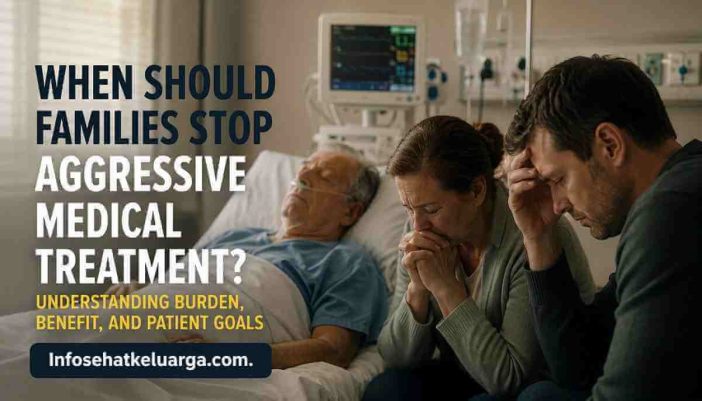
In intensive care units, oncology wards, and long-term hospital rooms, families often hear phrases that sound medically precise but emotionally devastating:
“We need to discuss goals of care.”
For many relatives, this moment feels less like a medical conversation and more like an invisible line between hope and fear. Some respond by demanding every possible intervention. Others quietly wonder whether continued aggressive treatment is prolonging suffering rather than recovery.
The reality is more complicated than either instinct suggests.
Aggressive medical treatment is not automatically wrong, and stopping escalation is not automatically abandonment. The central question is whether treatment is still aligned with the patient’s condition, values, and realistic goals.
This discussion is part of our broader Medical Ethics, Consent & Decision-Making framework, where we examine how difficult healthcare decisions are navigated responsibly under uncertainty.
What Aggressive Medical Treatment Usually Means
Aggressive treatment generally refers to interventions intended to:
- prolong life,
- stabilize critical illness,
- or attempt recovery despite severe medical risk.
Examples include:
- mechanical ventilation,
- repeated ICU admission,
- dialysis during multi-organ failure,
- advanced chemotherapy in late-stage disease,
- resuscitation attempts,
- invasive surgery in medically fragile patients.
Aggressive treatment is not inherently inappropriate. In many cases, it saves lives.
The challenge arises when the burden of treatment begins to outweigh its realistic benefit.
Why Families Struggle With This Decision
Families rarely evaluate treatment decisions purely medically.
They are also coping with:
- fear,
- anticipatory grief,
- guilt,
- exhaustion,
- unresolved family dynamics,
- religious beliefs,
- and uncertainty about prognosis.
Many relatives fear that reducing treatment intensity means:
- “giving up,”
- abandoning hope,
- or causing harm.
In reality, healthcare teams often evaluate a different question:
Is treatment still helping the patient achieve meaningful goals?
That distinction changes the entire conversation.
When Doctors Begin Questioning Aggressive Treatment
Healthcare teams may reconsider aggressive treatment when:
- recovery probability becomes extremely low,
- interventions no longer improve quality of life,
- suffering increases significantly,
- repeated procedures produce minimal benefit,
- or treatment merely prolongs the dying process biologically.
This does not mean doctors are “stopping care.”
Often, they are reconsidering:
- the type of care,
- the goals of care,
- and whether interventions remain proportional to expected benefit.
Burden vs Benefit: The Core Medical Framework
One of the most important concepts families rarely hear explained clearly is:
treatment burden versus treatment benefit
Treatment Burden May Include:
- pain,
- prolonged sedation,
- inability to communicate,
- repeated invasive procedures,
- severe side effects,
- prolonged ICU dependency.
Treatment Benefit May Include:
- meaningful recovery,
- symptom improvement,
- restoration of function,
- or survival aligned with patient wishes.
Aggressive treatment becomes ethically difficult when:
- burden rises sharply,
- but meaningful benefit becomes increasingly unlikely.
Why “Doing Everything Possible” Is Not Always Simple
Families often say:
“We want everything done.”
Emotionally, this is understandable.
But medically, “everything” may include:
- traumatic procedures,
- low-probability interventions,
- severe suffering,
- or treatments unlikely to change outcome meaningfully.
Doctors may therefore ask:
“What would the patient consider acceptable quality of life?”
This question is central to ethical medical decision-making.
The Role of Patient Wishes
The most important voice in these situations is usually the patient’s own.
This is why:
- advance directives,
- healthcare proxies,
- and prior conversations matter enormously.
Our guides on:
- Advance Directives and Family Authority in Medical Decisions
- Power of Attorney in Medical Decisions
- Do Not Resuscitate (DNR) Orders Explained
help clarify how authority works when patients cannot speak for themselves.
Without clear patient wishes, families often experience greater conflict and uncertainty.
When Families and Doctors Disagree
Conflict commonly occurs when:
- doctors believe treatment is medically non-beneficial,
- while relatives still hope for recovery.
These disagreements may involve:
- ventilator continuation,
- repeated resuscitation,
- feeding tube placement,
- ICU escalation,
- or transition to palliative-focused care.
This tension is explored further in:
When Families Disagree With Doctors: Rights, Limits, and Safe Resolution
The goal should not be “winning” the disagreement.
It should be reaching the most ethically and medically responsible decision possible.
Palliative Care Does Not Mean “Giving Up”
One of the biggest misconceptions is that palliative care means abandoning treatment.
In reality, palliative care focuses on:
- symptom relief,
- comfort,
- communication,
- emotional support,
- and quality of life.
Patients may receive palliative care:
- alongside active treatment,
- during chronic illness,
- or during end-of-life care.
Understanding this distinction reduces unnecessary fear.
Practical Decision Framework for Families
When evaluating aggressive treatment decisions, families should ask:
1. What is the realistic medical goal?
Recovery? Stabilization? Temporary extension of life?
2. What burdens is the patient experiencing?
Pain, sedation, distress, repeated procedures?
3. What would the patient likely want?
Not what relatives want emotionally.
4. Are doctors discussing prognosis honestly?
Families should feel comfortable asking direct questions.
5. Is treatment changing outcome—or only delaying it?
These conversations are emotionally difficult but medically essential.
Real-World Scenario
An elderly patient with advanced organ failure remains in ICU after multiple complications.
The family requests:
- continued ventilation,
- repeated resuscitation,
- and additional invasive procedures.
Doctors explain:
- survival probability is extremely low,
- neurological recovery is unlikely,
- suffering burden is increasing.
The conflict is not about whether the family “cares enough.”
It is about whether treatment remains proportionate to meaningful benefit.
Understanding this distinction often changes the tone of the discussion.
Trust & Verification Note
Because aggressive treatment decisions involve high-risk medical and ethical considerations, families should seek guidance from:
- licensed physicians,
- palliative care specialists,
- hospital ethics services,
- and legal professionals where appropriate.
This article is educational and should not replace individualized medical advice.
Frequently Asked Questions
Does stopping aggressive treatment mean stopping all care?
No. Patients may continue receiving pain relief, oxygen, nutrition support, comfort care, and other medically appropriate treatment.
Can families insist on continuing treatment?
Sometimes, but hospitals may evaluate whether interventions remain medically appropriate and ethically justified.
Is palliative care the same as hospice?
No. Hospice is one type of end-of-life care, while palliative care may occur alongside ongoing treatment.
Who makes the final decision if the patient cannot speak?
Decision authority depends on advance directives, healthcare proxy status, and applicable law.
Why These Decisions Are Ultimately About Goals, Not Surrender
Most families do not struggle because they lack love. They struggle because medicine can extend biological survival longer than ever before, while offering no simple formula for what should happen next.
The hardest healthcare decisions are rarely about choosing between “fighting” and “giving up.” They are about determining whether treatment still serves the patient’s goals, dignity, and realistic chances of recovery.
Clarity does not remove grief. But it can reduce confusion, guilt, and conflict when families need guidance most.