
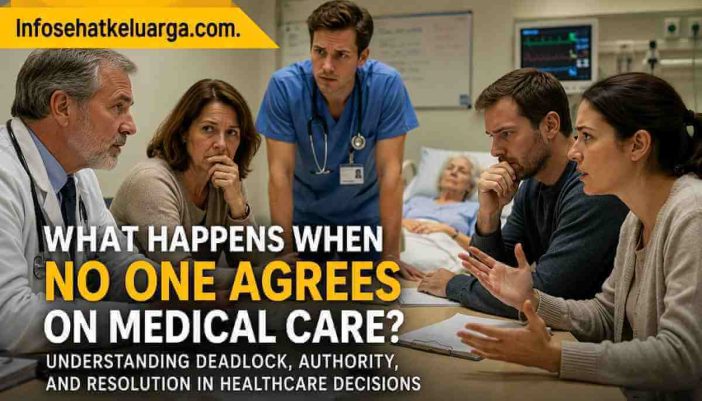
The patient wants one thing.
A spouse wants another.
Adult children disagree among themselves.
The medical team has concerns about treatment options.
Hours pass. Emotions rise. Conversations become repetitive. Everyone believes they are acting in the patient’s best interest, yet no clear path forward emerges.
This kind of healthcare deadlock is more common than many people realize.
Contrary to popular belief, hospitals do not simply allow the loudest voice to decide. Healthcare systems rely on ethical frameworks, legal authority structures, clinical judgment, and patient-centered principles to navigate situations where nobody agrees.
Understanding how these conflicts are resolved can help families approach difficult conversations with greater clarity and less fear.
This article belongs to our broader Medical Ethics, Consent & Decision-Making hub, which explores how consent, authority, patient rights, and ethical responsibility interact during complex healthcare decisions.
Why Medical Decision Deadlocks Happen
Most healthcare conflicts are not caused by bad intentions.
They emerge because different people focus on different priorities.
Patients may prioritize:
- independence,
- dignity,
- comfort,
- quality of life.
Family members may prioritize:
- survival,
- treatment opportunities,
- avoiding regret,
- hope for improvement.
Healthcare professionals may focus on:
- medical effectiveness,
- clinical risk,
- likely outcomes,
- professional obligations.
These perspectives are not necessarily incompatible, but under stress they can pull decisions in different directions.
The First Question: Can the Patient Still Decide?
The most important starting point is determining whether the patient still has decision-making capacity.
If the patient can:
- understand information,
- appreciate consequences,
- reason about options,
- communicate a choice,
their wishes generally guide care.
This principle is explored in Medical Decision-Making Capacity Explained.
Many conflicts disappear once authority is clarified.
If a patient retains capacity, disagreement from relatives usually does not transfer decision-making authority away from the patient.
When the Patient Cannot Decide
If capacity is lost, healthcare teams must identify who has authority to speak on the patient’s behalf.
This may involve:
- advance directives,
- healthcare proxies,
- power of attorney documents,
- legally recognized surrogate decision-makers.
The process is explained further in:
Without documentation, disagreement often becomes more complicated.
What Happens When Family Members Disagree?
Family disagreements are among the most difficult situations hospitals face.
Common conflicts include:
- one child wants aggressive treatment,
- another supports comfort-focused care,
- relatives disagree about prognosis,
- family members interpret patient wishes differently.
Healthcare teams usually do not resolve these conflicts by voting.
Instead, they try to determine:
- what the patient wanted,
- who has legal authority,
- what options are medically appropriate.
The goal is not family consensus at any cost.
The goal is ethically responsible decision-making.
When Families and Doctors Disagree
Sometimes conflict occurs between relatives and healthcare professionals.
Examples include:
- requests for treatment doctors believe will not help,
- disagreements about surgery,
- disputes regarding life support,
- questions about prognosis,
- requests for interventions considered medically inappropriate.
These situations are explored further in When Families Disagree With Doctors: Rights, Limits, and Safe Resolution.
Understanding the reasons behind disagreement is often more productive than arguing about outcomes.
Why Hospitals Do Not Simply Follow Family Demands
Many people assume families automatically control healthcare decisions when patients are seriously ill.
In reality, healthcare teams must balance:
- patient autonomy,
- professional ethics,
- clinical judgment,
- legal obligations,
- institutional policies.
Doctors generally cannot provide treatment solely because someone demands it.
Likewise, they cannot ignore patient wishes when those wishes are known and valid.
Healthcare decisions exist within ethical and professional boundaries.
The Role of Ethics Committees
When disagreements become particularly difficult, hospitals may involve ethics consultation services.
Ethics committees do not function as courts.
They do not “win” arguments for one side.
Instead, they help clarify:
- ethical principles,
- authority structures,
- communication barriers,
- conflicting values,
- patient-centered goals.
Our article How Hospital Ethics Committees Work in Family Disputes explains this process in greater detail.
Ethics consultation often helps transform emotional conflict into structured discussion.
Original Value Section: The Healthcare Deadlock Framework
When nobody agrees, families can use the following framework.
Step 1: Clarify Authority
Ask:
Who legally has authority to decide?
Many conflicts become easier once authority is understood.
Step 2: Clarify Patient Wishes
Ask:
What would the patient choose if they could fully participate?
This question often matters more than family preferences.
Step 3: Clarify Medical Reality
Ask:
What outcome is realistically possible?
Hope should be informed by evidence rather than assumptions.
Step 4: Clarify Goals
Ask:
Are we trying to cure, stabilize, prolong life, or maximize comfort?
Conflicts frequently arise because participants are pursuing different goals without realizing it.
Step 5: Clarify Next Steps
Ask:
What decision must actually be made right now?
Breaking large conflicts into smaller decisions often reduces tension.
A Realistic Scenario
An elderly patient develops severe complications after prolonged hospitalization.
One child requests every possible intervention.
Another believes treatment burden has become excessive.
Doctors explain that additional procedures are unlikely to improve recovery.
Nobody agrees.
At this point, the conflict is not simply about treatment.
It is about:
- authority,
- goals,
- interpretation of patient wishes,
- understanding medical reality.
The solution usually comes from clearer communication rather than stronger argument.
Why Documentation Matters Before Crisis
Many conflicts occur because critical conversations never happened.
Families often avoid discussing:
- life support,
- resuscitation,
- long-term disability,
- healthcare preferences,
- quality-of-life priorities.
Advance planning can significantly reduce uncertainty later.
Readers may also find value in:
- Patient Wishes vs Family Wishes: Who Has the Final Say in Medical Decisions?
- Do Not Resuscitate (DNR) Orders Explained
- When Should Families Stop Aggressive Medical Treatment?
These topics frequently intersect during healthcare deadlocks.
Trust & Verification Note
Healthcare disputes may involve legal, ethical, and clinical considerations that vary by jurisdiction and individual circumstances.
This article is educational and should not be used as a substitute for professional medical, legal, or ethics consultation.
Families facing urgent healthcare conflicts should work directly with treating clinicians and appropriate specialists.
Frequently Asked Questions
Can hospitals make decisions if families cannot agree?
Hospitals generally rely on patient wishes, legal authority structures, and clinical standards rather than family consensus alone.
What if no healthcare proxy exists?
The healthcare team may rely on surrogate decision-making rules established by law or institutional policy.
Can an ethics committee overrule a family?
Ethics committees usually provide guidance and analysis rather than direct legal authority.
What if everyone involved believes they are right?
This is common. Healthcare conflict often reflects competing values rather than bad intentions.
Why Resolution Usually Starts With Clarity
Most healthcare deadlocks are not caused by a lack of caring.
They are caused by uncertainty.
People disagree about authority. They disagree about prognosis. They disagree about what the patient would want. They disagree about what outcomes matter most.
The path forward rarely begins with finding a winner.
It begins with clarifying whose voice should guide the decision, what medical reality allows, and what goals best reflect the patient’s values.
When those questions are answered honestly, even difficult disagreements become easier to navigate.